Sermon Transcript
“Tell the daughter of Zion, Look, your king is coming to you, humble, and mounted on a donkey, and on a colt, the foal of a donkey.” (Matthew 21:5)
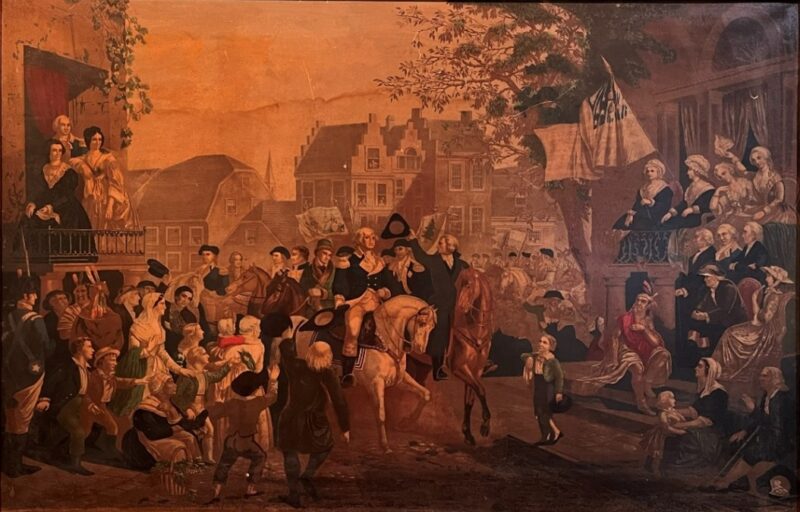
Washington’s Triumphal Entry into New York. Chromolithograph, P.S. Duval & Son, Philadelphia, 1860.
On Palm Sunday, we celebrate the triumphal entry of Jesus into Jerusalem. In pondering the meaning and mystery of today, I recalled a particular scene from the American Revolution was never far from my eyes as a child. You see, my parents owned a large painting that hung in our dining room. Actually, it’s not a painting, but a chromolithograph that illustrates George Washington’s triumphal entry into New York City. These days the painting belongs to my brother and hangs in his house. Last week I asked him to take a photo of it and send it to me, so that I could drop it into our Palm Sunday bulletins for all to see.
The date was November 25, 1783, a day that came to be known as Evacuation Day. The long war for American independence had finally, officially ended with the signing of the Treaty of Paris in September. The treaty allowed for an orderly British evacuation of the colonies, but doing so would be easier said than done. In New York City alone, unwinding seven years of occupation simply could not happen overnight. The British commander, General Guy Carleton, would have to arrange transport and supplies for thousands of troops, loyalists, and slaves who had been freed under English rule, and who, understandably, were reluctant about sticking around and taking their chances with the Americans. Also he would have to maintain order as the old kingdom gave way to something new and untested. Carleton frequently corresponded with General George Washington and New York Governor George Clinton, and it does seem that the peaceful transfer of power was of concern for all.
The plan called for British troops to take down their flag and sail out of New York Harbor at noon on the appointed day. Then, an American general, Henry Knox, would immediately secure the city. When Washington finally received word that all was in order, he assembled his remaining soldiers and other dignitaries at what is now Union Square, where the great statue portrays him on Evacuation Day. There they met with citizens and began a stately procession down the Bowery. The painting in your bulletin depicts the scene at Bowery and 3rd St. The church spire in the background is quite possibly St. Mark’s. Mounted on horseback, George Washington and Governor Clinton led the way. The crowds that lined the street and those that followed were euphoric. The people who greeted him at the northern edge of the city – in those days, Chambers Street – were delirious with joy. They were free. By entering the city, Washington was inaugurating a new age. Some even wanted to crown him king. But Washington did not want to be a king. Washington was humble, honest, gracious, thoughtful, and eloquent: all qualities we’ve come to expect in our Presidents. In 1789, the Evacuation festivities lasted for more than a week, including dinners at Fraunces’ Tavern, where, incidentally, you’ll find another print of the same scene. Finally, the great General said farewell, and departed for his home at Mt. Vernon.
For the better part of the next century the people of New York City commemorated Evacuation Day, but as time wore on the picture faded from their eyes. After one last push on the centennial in 1883 the day all but disappeared from our national calendar. A curiously similar day, however, has never lost its hold on the Christian calendar. Today is Palm Sunday, the day we commemorate the triumphal entry of Jesus into Jerusalem. Mounted on a donkey, in the midst of a great procession of Passover pilgrims, Jesus approached the gates of the city. Matthew tells us that those who went ahead of him and those who followed were delirious with joy. They shouted “Hosanna to the Son of David! Blessed is the one who comes in the name of the Lord! Hosanna in the highest heaven!”
Those original Palm Sunday participants believed that by entering Jerusalem, Jesus was inaugurating a new age. In fulfillment of ancient prophecies, their true king was coming. Indeed, this was the king’s march. The Messiah, God’s Anointed One had arrived to establish a reign of justice, righteousness, and peace. It was the time of Passover, so the walled city of Jerusalem, with a normal population of approximately 50,000, might have swelled to nearly a million as additional pilgrims came pouring into the region. I’ve always imagined that as Jesus entered the gates, the city ground to a standstill as all these people spread their cloaks in his path and waved palm branches to welcome him. The sheer joy and accompanying pandemonium would be impossible to miss. This was a day a thousand years in the making. The Jews had been waiting for it since the time of King David.
But how was it, really? Did a million Jews, all of one mind, really bring the city to a halt with palm branches and strewn cloaks and shouts of Hosanna? Matthew implies that two different crowds were in operation on the first Palm Sunday. The first crowd consisted of what was likely a growing company of Passover pilgrims traveling with Jesus. They would have been on a journey of several days at least. As they made their way to the city, more and more would have joined the procession, chanting Psalms and telling stories of the Exodus as they made their way. Jesus would have been at the center of the crowd, teaching in parables and dropping clues to his identity and mission. It’s easy to imagine how the crowd traveling with Jesus would be caught up in his talk about a new kingdom – the kingdom of heaven. This was the crowd – perhaps several hundred to a thousand strong – that gave Jesus a royal welcome when he arrived at the gates of Jerusalem. This was the crowd that shouted Hosanna.
Nevertheless, the first crowd was to meet a second crowd. Matthew tells us that when Jesus entered Jerusalem, the whole city was in turmoil, asking, “Who is this?” The second crowd consisted of the residents of Jerusalem, most of whom had no idea who Jesus was, nor would they have any patience for his disrupting their day. The second crowd probably looked at the first crowd as a minor annoyance: just another group of arriving Passover pilgrims chanting that they wanted something, and wanted it now. It’s likely that it was the second crowd who would demand the crucifixion of Jesus within five days. Matthew implies that those who shouted “Hosanna” on Palm Sunday were not the ones who cried out “Crucify, crucify him” on Friday. These were two different crowds. Thus, it was hardly a unified welcome that greeted Jesus in Jerusalem.
What else did he find? When Washington entered New York City, a peace treaty had been signed, and the occupying powers had evacuated. True, the British deliberately left behind their flag. They had nailed a Union Jack to the top of the flag pole in Battery Park, and they greased the pole so no one could climb it. But the point is, it was a departing prank. The British had evacuated. When Jesus entered Jerusalem, the Romans had done nothing of the sort, and signing peace treaties with populist kings was not their policy. So what kind of kingdom could Jesus hope to establish in a city still occupied by the overwhelming military might of the Roman Empire? And as for peace, what peace? The only peace to be found was the unholy collusion between the Romans and Jewish authorities to keep the restive public in line. Still to this day, the type of historical, universal, palpable peace that the Messiah was to bring eludes us. What was Jesus hoping to accomplish? “Who is this?” wondered the people of Jerusalem. They didn’t seem to know, and the same can be said for much of the world today, even those of us here who shout Hosanna. Presumably, we are in the first crowd, but we don’t know who Jesus is, or what to make of him.
“Who is this,” asked the second crowd. Who is Jesus? Every year on Palm Sunday, the Gospel writers Matthew, Mark, and Luke go to great lengths to explain how Jesus procured the donkey he would ride into the city. It’s as if the donkey holds the clue to the mystery of Palm Sunday and all of Holy Week. If you’re a movie buff, then perhaps you’ve seen the 1976 film, All the President’s Men, starring Robert Redford and Dustin Hoffman. Redford and Hoffman portray the two Washington Post reporters assigned to unravel the conspiracy behind the Watergate break-ins that toppled President Nixon. Initially the two reporters get nowhere until they meet an informant, code named “Deep Throat,” who tells them to “follow the money.” For our purposes today, allow me to suggest a paraphrase: “follow the donkey.” The Gospel writers all recommend that we follow the donkey in order to understand who Jesus is, and what he was trying to do.
Matthew reminds us of an ancient oracle from the prophet Zechariah (9:9) declaring that God’s chosen Messiah would arrive in the city riding a donkey. Any good Jew who had hoped for the Messiah and studied the Scriptures would have known it. If Washington made careful plans for his triumphal entry, so did Jesus. Jesus took deliberate steps to secure the donkey. It didn’t just happen by magic and mystery. A secret follower in the city had just the right humble beast, and Jesus made arrangements well in advance for his disciples to acquire it with a series of passwords. Jesus might easily have arranged for a different style of entry. He could have raised up an army of rebels and come through the gates with a war horse and chariot to take on the Romans. But he knew that to engage the worldly powers with their own weapons would be to lose the moral and spiritual victory before the fight began. Rather, his aim was to stand in God’s strength alone, following God’s script in the Scriptures.
In studying the Scriptures, Jesus would have encountered not only the donkey, but also the mysterious figure we heard about in today’s reading from Isaiah (50:4-9) – a figure we’ve come to call the Suffering Servant. Jesus would reach two revolutionary conclusions: First, it was to be this figure – not a military warrior – who was to ride the donkey. Indeed, the long-awaited Messiah was, in fact, the Suffering Servant. Jesus made the connection that no one else had made. Second, this figure, this Suffering Servant, was none other than himself. Jesus discerned that his vocation was to suffer and die on behalf of the people, and that God would redeem them through his suffering and death. It is hardly logical to our 21st century minds. It is about as logical and linear as our opening Palm Sunday procession, which meandered round and round the church rather than simply going directly from Point-A to Point-B. The ways of God are strange to us.
When I was growing up, Washington’s triumphal entry was never far from my eyes. Through many long family dinners I would stare at the painting and think, “How could you not want to be on the great general’s side, and ride on, ride on in majesty with him? Who wouldn’t want to stand up for him? Yet even as I looked I could see faces in the crowd that appear decidedly indifferent, or worse. Behold another general high in the balcony to the left who seems to sneer down enviously at Washington. And the American Indian, seated on the right – we can imagine his thoughts: “Who is this new king coming on his horse? Will he be yet one more conquering tyrant to rule over my people, or will this one be different?”
Evacuation Day has faded from our sight, but the Church, in her wisdom, has declared that Palm Sunday is a scene that never should be far from our eyes. Palm Sunday presses the questions: Who is this? Who is Jesus? What will it mean and what will it cost really to follow him? What will it mean to leave the second, cynical, indifferent crowd, and join the first that shouts Hosanna? Look, your king is coming to you, humble, and mounted on a donkey, and on a colt, the foal of a donkey.
+
The Weekly Epistle
Read our weekly newsletter for parish updates and a word from our Rector.
Read The Weekly EpistleMusic List
March 29, 2026
The Adult Choir
At the Procession:
Hymn 154, All glory, laud, and honor…….VALET WILL ICH DIR GEBEN
Hymn 561, Stand up, stand up for Jesus…….MORNING LIGHT
Hymn 156 Ride on! Ride on in majesty!…….THE KING’S MAJESTY
At the Offertory, The Palms…….Jean Baptiste Faure (1830-1914)
At the Presentation, Hymn 474, vs. 4…….ROCKINGHAM
Hymnal S-114, Sanctus…….Healey Willan (1880-1968)
Hymnal S-158, Agnus Dei…….Healey Willan
At the Communion:
Hymn 313, Let thy Blood in mercy poured…….JESU, MEINE ZUVERSICHT
Hymn 315, Thou, who at thy first Eucharist didst pray…….SONG 1
Hymn 158, Ah, holy Jesus…….HERZLIEBSTER JESU
Hymn before the Passion, Hymn 171, Go to dark Gethsemane…….PETRA
Prelude, Marche Réligieuse…….Alexandre Guilmant (1837-1911)
…..On the theme of the chorus “Lift up Your Heads, O Ye Gates” from Handel’s “The Messiah”
At 4 pm, The Adult Choir will offer John Henry Maunder’s (1858-1920) “Olivet to Calvary.”
Get Connected
Subscribe to our contact list to receive the latest updates, inspiring stories, and invitations to community events.