
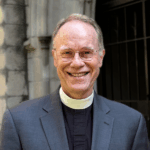
Sermon Transcript
When Jesus received the wine, he said, “It is finished.” Then he bowed his head and gave up his spirit. (John 19:30)
People of faith have claimed that God will occasionally set before their eyes some common, ordinary thing that is actually a window into a larger, transcendent reality. Case in point: Amos the prophet. One day Amos was standing beside a newly built wall. Nearby was a plumb line that the builder had used to make it straight. The Lord said to Amos (7:8), “Amos, what do you see?” Amos looked at the plumb line and correctly identified the ordinary object in front of him, replying, “A plumb line.” But the Lord said to Amos: Look again. You may see a plumb line, but I see judgment in the midst of Israel.
On another occasion Amos noticed a basket of summer fruit (8:1), and again the Lord said, “Amos, what do you see?” Amos replied, “A basket of summer fruit,” thinking that he’d hit the nail right on the head. Wrong again, Amos, said the Lord. You may see a basket of summer fruit, but I see that the end has come upon my people Israel. In both cases the common thing revealed a deeper and disturbing reality.
So it may have been for me one day, thirty years ago, in February of 1996. Not even a week earlier my strong, vigorous father had died suddenly from an unexplained cerebral hemorrhage deep in his brain. On a Friday morning he had been out playing tennis. He drove home and reclined for a nap before lunch, but from this nap he would never awaken. Family from near and far had gathered for Dad’s final moments and his funeral. Now a few days on it was the task of my two brothers and me to clean out his office at the church where he had been the rector for eleven years. One thing I found on his desk was a cup of water, still half full. No doubt, the previous Thursday Dad had filled his cup at the sink, never imagining, of course, that he would not live to finish the drink he had just poured. That afternoon he would sip the water while he worked at his desk. The phone would ring. Appointments would come and go. He forgot about the water. The day ended. His life ended. The cup of water remained, unfinished.
What did I see? On one level I saw an unfinished cup of water. But on a deeper level I saw nothing short of an unfinished life. My father was living life in full stride, with plenty of gas in the tank for whatever might come next. But it was not to be. He would never get to retire, never meet any of his four grandchildren who would be coming along in just a few short years, and never reap the rewards of all the decades of hard work. He was not finished.
We come now to the sixth of the seven last words or phrases that Jesus uttered from the cross: “It is finished.” Of the seven last words, John records three of them in rapid succession, all within four verses of his Gospel. First Jesus commended his mother to the care of the beloved disciple. After this, when Jesus knew that all was now finished, he said (in order to fulfill the scripture), “I am thirsty.” A jar full of sour wine was standing there. So they put a sponge full of the wine on a branch of hyssop and held it to his mouth. When Jesus had received the wine, he said, “It is finished.” Then he bowed his head and gave up his spirit. The first question we might ask is: What was finished? Was Jesus referring to the sour wine? Could he have meant that by seeing to his mother’s care his earthly affairs were now finished? What did he mean?
One possibility we don’t like to consider is that Jesus essentially was saying, “The movement is finished.” The campaign to establish the kingdom of God on earth has failed to achieve its ends. All is lost. Could it really be that Jesus meant that his movement had collapsed? Well, Biblical scholars assure us that John was clear about the Greek word he chose for finished. John did not want anyone to think that Jesus was saying, It is over, or, It is ended, as if his mission were meeting an abrupt and disgraceful defeat. The English word finished can be slightly ambiguous, but the Greek is not. What John records Jesus to be saying is, It is accomplished, or, It is completed. The movement is not defeated. Quite the contrary, the kingdom of God is established. All is forgiven. All that was lost in the fall from grace is restored. The work of redemption is finished.
An image comes that comes to mind here is from the 1980 film, The Elephant Man. The movie tells the story of John Merrick, whose first name was actually Joseph. Merrick lived in 19th century London, and suffered from several horribly disfiguring ailments. Despite his shocking appearance he was actually a gentle soul. In his hospital apartment he built a model church from a cardboard kit he’d received as a gift. The work was painstaking because he had only one usable hand. The model is magnificently detailed, and survives to this day. In the movie, Merrick puts the final touches on the church, then says It is finished, before lying down to sleep for the night. But from this sleep he would never awaken. What was finished? The model church? Yes, but viewers are left to consider that Merrick had, in his own way, strangely fulfilled the will of God through his tortured life.
Jesus finished his mission. Even still, we might hit the pause button momentarily on any triumphant theological rhetoric and listen to the concerns of those who think that the kingdom of God is anything but established. They point to a world that continues in its sinful ways, from the day Jesus said “it is finished” until now. Nothing has changed. The sheer quantity of unatoned for, unaddressed sin staggers the mind. How can Jesus say it is finished? To claim that the work of redemption is complete is a miscarriage of justice. Who absorbs the net loss to society of all the evil we do to each other?
Perhaps the other canonical Gospels can provide a clue. Matthew, Mark, and Luke record that at the death of Jesus the curtain of the temple was torn in two, from top to bottom. The curtain, or veil, hung at the entrance to the Holy of Holies – the most sacred place in the temple. Behind it at various times was the Ark of the Covenant, the Mercy Seat, even the presence of God. In the days of Jesus, only the high priest was allowed to pass through the veil, and even then just once per year on the Day of Atonement. Why? Because he was entering the sacred confines of God: God’s inner chamber. When Jesus spoke his last words, did the veil actually tear in two? Perhaps it did. Or perhaps the three Evangelists were providing a visual image to convey that in the crucifixion of Jesus we see into the very depths of God. On the surface, Good Friday is one moment in time, yes. But all four Gospel writers want us to look beneath the surface and see a timeless reality that is eternally at the heart of God: self-sacrificial love. God, who is love, who dwells in light inaccessible from before time and forever, takes on, bears, and absorbs the sins of the world – not just on one day, but every day.
When we survey the wondrous cross we are looking at time and eternity simultaneously. It’s all happening, all at once in God’s eternal now. Various commentators point out that God first declared “it is finished” at the beginning of time, on the seventh day of creation: Thus the heavens and the earth were finished, and all the host of them. And on the seventh day God finished his work which he had done (Genesis 2:1). God finished his work, but was God’s work finished? Hardly. Humankind, the crown of God’s achievement, would go on to disobey the command of God and fall from grace. No longer would we enjoy the perfect presence of God. True love would always be in sight, within our primal memory, but hauntingly just out of reach. Nevertheless, God was determined to bring us back.
The next time we hear God declare “it is finished” is in the midst of time, on the cross of Christ. Remember, this is God on the cross. The atonement is not possible without the Incarnation. Good Friday is not good without Christmas. Cross and Incarnation mingle together. Both are on stage and in motion today, together at once. This is God on the cross, feeling the pain, absorbing the loss. God, who determined that not one of those who belong to him should be lost, dared to take on himself the unaddressed, unatoned for, unforgiven sins of the whole world. It is accomplished.
The third and final time we hear God declare “it is finished” is at the end of time, when the new Jerusalem comes down out of heaven, prepared as a bride adorned for her husband. And he who sat upon the throne said, “See, I am making all things new.” Then he said to me, “It is done! I am the Alpha and the Omega, the beginning and the end. To the thirsty I will give water as a gift from the spring of the water of life. Those who conquer will inherit these things, and I will be their God and they will be my children (Revelation 21:5-7). It is done. It is accomplished. It is finished.
Thirty years ago, while cleaning out my father’s office, the sight of his unfinished cup of water was almost more than I could bear. If memory serves, my brothers and I each took a sip of it until it was gone. It was finished. When Jesus said of the wine, “It is finished,” he too meant to say that he had drunk the cup which the Father had given him. But his meaning was on another level. He had accomplished the will of God. He had built the church. He had established the communion through which you and I come into God’s embrace. What do I see? I see hope for you and me and all of us who will not finish the race that is set before us. Christ will finish it for us.
At a recent Wednesday evening Bible study, a participant asked me what my favorite verse of Scripture happened to be. I didn’t have to think long to reply. It comes from the sixth chapter of John. Thousands of people had followed Jesus out into the wilderness to hear him preach. At the end of the day everyone was hungry, but all they had were five loaves and two fish. Nevertheless, Jesus took the loaves and fish, and in blessing them, multiplied them so that five-thousand people had more than they could possibly finish. What did Jesus do? He looked at the trail of broken bread crumbs, and he told his disciples 6:12), “Gather up the fragments that remain, that nothing be lost.”
What do I see? What do I hear? I see Jesus looking at the trail of broken bread crumbs that is your life and mine: the things left undone that we ought to have done, the love given and taken for granted, the opportunities squandered, the cups of water unfinished. But when I hear him say, “Gather up the fragments that remain, that nothing be lost,” I know that our lives are already gathered up into God’s eternal now, in that kingdom where he is the Alpha and the Omega, the beginning and the end: where the thirsty drink water from the spring of the water of life, where death shall be no more, where God shall wipe away every tear from our eyes.
+
The Weekly Epistle
Read our weekly newsletter for parish updates and a word from our Rector.
Read The Weekly EpistleMusic List
April 3, 2026
Hymn 167, There is a green hill far away…….HORSLEY
Hymn 140, Wilt thou forgive that sin…….DONNE
Hymn 170, To mock your reign, O dearest Lord…….THE THIRD TUNE
Hymn 159, At the cross her vigil keeping…….STABAT MATER
Hymn 158, Ah, holy Jesus…….HERZLIEBSTER JESU
Hymn 168, O sacred head, sore wounded…….HERZLICH TUT MICH VERLANGEN
Hymn 171, Go to dark Gethsemane…….PETRA
Hymn 458, My song is love unknown…….LOVE UNKNOWN
All Good Friday Sermons
Father, forgive them, for they know not what they do.
Preaching: Ms. Molly Gouran
Listen to the Sermon
Truly I tell you, today you will be with me in paradise.
Preaching: The Rev. James H.B. Morton III
Listen to the Sermon
Woman, behold your son… Behold your mother.
Preaching: The Very Rev. Harry E. Krauss
Listen to the Sermon
My God, my God, why have you forsaken me?
Preaching: The Rev. Eva N. Suarez
Listen to the Sermon
I thirst.
Preaching: The Rev. Megan E. Sanders
Listen to the Sermon
It is finished.
Preaching: The Rev. J. Donald Waring
Listen to the Sermon
Father, into your hands I commend my spirit.
Preaching: The Rev. Robert M. Pennoyer
Listen to the Sermon
Get Connected
Subscribe to our contact list to receive the latest updates, inspiring stories, and invitations to community events.